

Freitag, 20. Juli 2012


Donnerstag, 19. Juli 2012
Ausstellung ab 27.06.2012 in der vhs Fürth /2. Stock „Brasilianische Lebensfreude“

Samstag, 7. Juli 2012

Mittwoch, 4. Juli 2012


Montag, 18. Juni 2012

Freitag, 8. Juni 2012


Presente de um ano de casamento.


 Feito em papel grain monyen-meium texture, tamanho A2-42x59, tecnica mista: lapis, lapis aqurela e tinta acrilica.
Mittwoch, 6. Juni 2012
Clarices 90x60 € 100
 "Eu não sou promíscua. Mas sou caleidoscópica: fascinam-me as minhas mutações faiscantes que aqui caleidoscopicamente registro."
Clarice Lispector
"Eu não sou promíscua. Mas sou caleidoscópica: fascinam-me as minhas mutações faiscantes que aqui caleidoscopicamente registro."
Clarice Lispector
Montag, 21. Mai 2012

Sonntag, 20. Mai 2012


Vorher I 100x 80 €200


Vorher II 3 teile 20 x 50 € 90


Dienstag, 24. April 2012


Montag, 23. April 2012

Montag, 19. März 2012
Mächtig was los zwischen Freiheit und Grünem Markt

Sonntag, 18. März 2012


Casal de Porta Bandeira zwei teile 30x50 € 80

The mestre-sala (The master of the Room)and porta-bandeira (she who carries the flag)displays the flag of the school to the audience. The porta-bandeira carries the flag, and the mestre-sala pays tribute and draws attention to both the flag and the porta-bandeira. Her dance is not a samba, but she spins and boughs her way ahead. The mestre-sala dances around her. All their moves are regulated in a set of rules, and at one point during the parade they are evaluated by the judges. The slightest mistake may result in their scores being lowered. For example: it is forbidden that the two give their backs to each other at the same time, and errors such as the drop of a hat or a slips will result in lower scores.[4][34][44] Their costumes are similar to the gala costumes typical of the eighteenth century, but "carnavalized", i.e. with an exaggerated amount of colors and decorations.
Currently, at least since the 1990s, the schools of the Special Group of Rio and São Paulo parade usually with three or four pairs of mestre-salas and porta-bandeira, but only the first is evaluated, the other being merely decorative, and optional. Normally, there to represent the school in some events where the main couple is unable to.[45]
The term mestre-sala seems to have been the carnival dances of the nineteenth century, in which there was a professional organization responsible for the hall that was called "master of room" or "master-room." With respect to the porta-bandeira the name was a natural adaptation of the old flag-bearer, character, usually male, who carries the heavy banners of Brazilian carnival groups


Capu 60x60 € 80
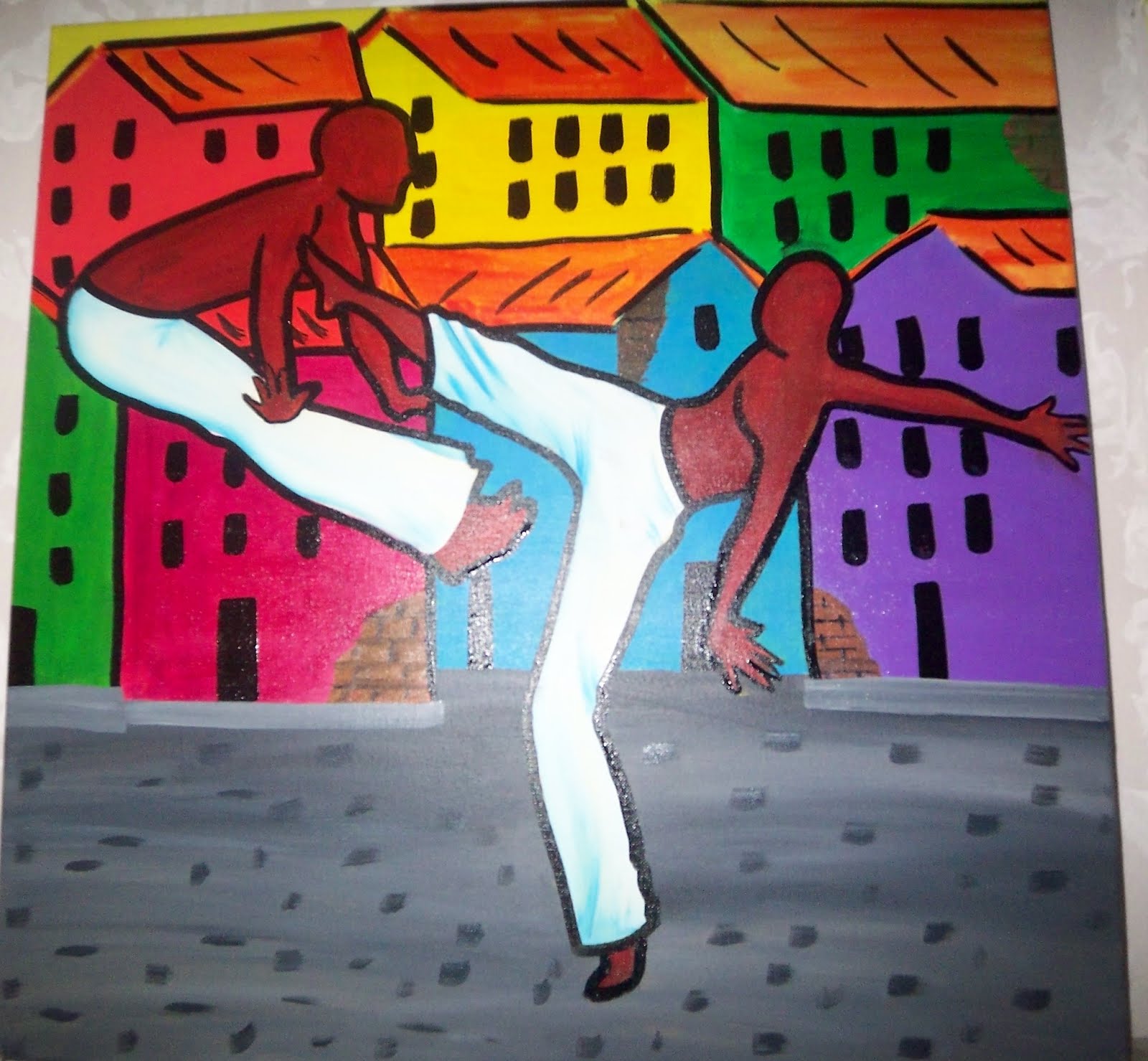
Capoeira's history probably begins with the adoption of African slavery in Brazil. Since the 16th century, Portugal extensively adopted slavery to man their colonies, coming mainly from West and Central Africa. Brazil, with its vast territory, was the major destination of African slaves, receiving 38.5% of all slaves sent by ships across the Atlantic Ocean.
Capoeira has a long and controversial history, since historical documentation in Brazil was very scarce in its colonial times. Evidences, studies and oral tradition leave little doubt about its Brazilian roots, but it is impossible to precisely identify the exact Brazilian region or time it began to take form.
Capoeira (Portuguese pronunciation: [kapuˈejɾɐ]) is a Brazilian martial art that combines elements of dance and music. It was created in Brazil mainly by descendants of African slaves with Brazilian native influences[citation needed], probably beginning in the 16th century. It is known by quick and complex moves, using mainly power, speed, and leverage for leg sweeps.
The word capoeira probably comes from Tupi, referring to the areas of low vegetation in the Brazilian interior.
In the 16th century Portugal had one of the biggest colonial empires of the world, but it lacked people to actually colonize it. In the Brazilian colony the Portuguese, like many European colonists, opted to use slavery to supply this shortage of workers. Colonists tried to enslave Brazilian natives in the beginning, but this quickly proved too difficult for many reasons, including the familiarity natives had with the land. The solution was importing slaves from Africa.[1]
In its first century the main economic activity in the colony was the production and processing of sugarcane. Portuguese colonists used to create large sugarcane farms called engenhos, farms which extensively used enslaved workers. Slaves, living in inhumane and humiliating conditions, were forced to work hard and often suffered physical punishment for any small misbehaviour.[1] Even though slaves outnumbered the Portuguese colonists, the lack of weapons, the colonial law, the disagreement between slaves coming from different African cultures and their complete lack of knowledge about the land and its surroundings would usually discourage the idea of a rebellion.
In this environment Capoeira began to develop. More than a fighting style, it was created as a hope of survival, a tool with which an escaped slave, completely unequipped, could survive in the hostile, unknown land and face the hunt of the capitães-do-mato, colonial agents armed and mounted in charge of finding escapees.

Abonnieren
Posts (Atom)