Montag, 19. März 2012

Mächtig was los zwischen Freiheit und Grünem Markt


Frühlingsmarkt und verkaufsoffener Sonntag in Fürth - Fredsonn Silva aus Brasilien ließ sich in der Gustavstraße beim Malen zuschauen.
Foto: Hans-Joachim Winckler 18.03.2012


Sonntag, 18. März 2012

Galerie der unbekannten Künstler

Galerie der unbekannten Künstler 1° Vernissagen 2011


Galerie der unbekannten Künstler 2° Vernissagen 2012


http://www.galerie-duk.de

O passo Vk

Amarlina Vk

Pescador 50x50 € 80

Casal de Porta Bandeira zwei teile 30x50 € 80


The mestre-sala (The master of the Room)and porta-bandeira (she who carries the flag)displays the flag of the school to the audience. The porta-bandeira carries the flag, and the mestre-sala pays tribute and draws attention to both the flag and the porta-bandeira. Her dance is not a samba, but she spins and boughs her way ahead. The mestre-sala dances around her. All their moves are regulated in a set of rules, and at one point during the parade they are evaluated by the judges. The slightest mistake may result in their scores being lowered. For example: it is forbidden that the two give their backs to each other at the same time, and errors such as the drop of a hat or a slips will result in lower scores.[4][34][44] Their costumes are similar to the gala costumes typical of the eighteenth century, but "carnavalized", i.e. with an exaggerated amount of colors and decorations.
Currently, at least since the 1990s, the schools of the Special Group of Rio and São Paulo parade usually with three or four pairs of mestre-salas and porta-bandeira, but only the first is evaluated, the other being merely decorative, and optional. Normally, there to represent the school in some events where the main couple is unable to.[45]
The term mestre-sala seems to have been the carnival dances of the nineteenth century, in which there was a professional organization responsible for the hall that was called "master of room" or "master-room." With respect to the porta-bandeira the name was a natural adaptation of the old flag-bearer, character, usually male, who carries the heavy banners of Brazilian carnival groups

Felicidade 50x50 €80

Sao.Cosme e Sao Damiao 70x50 € 100

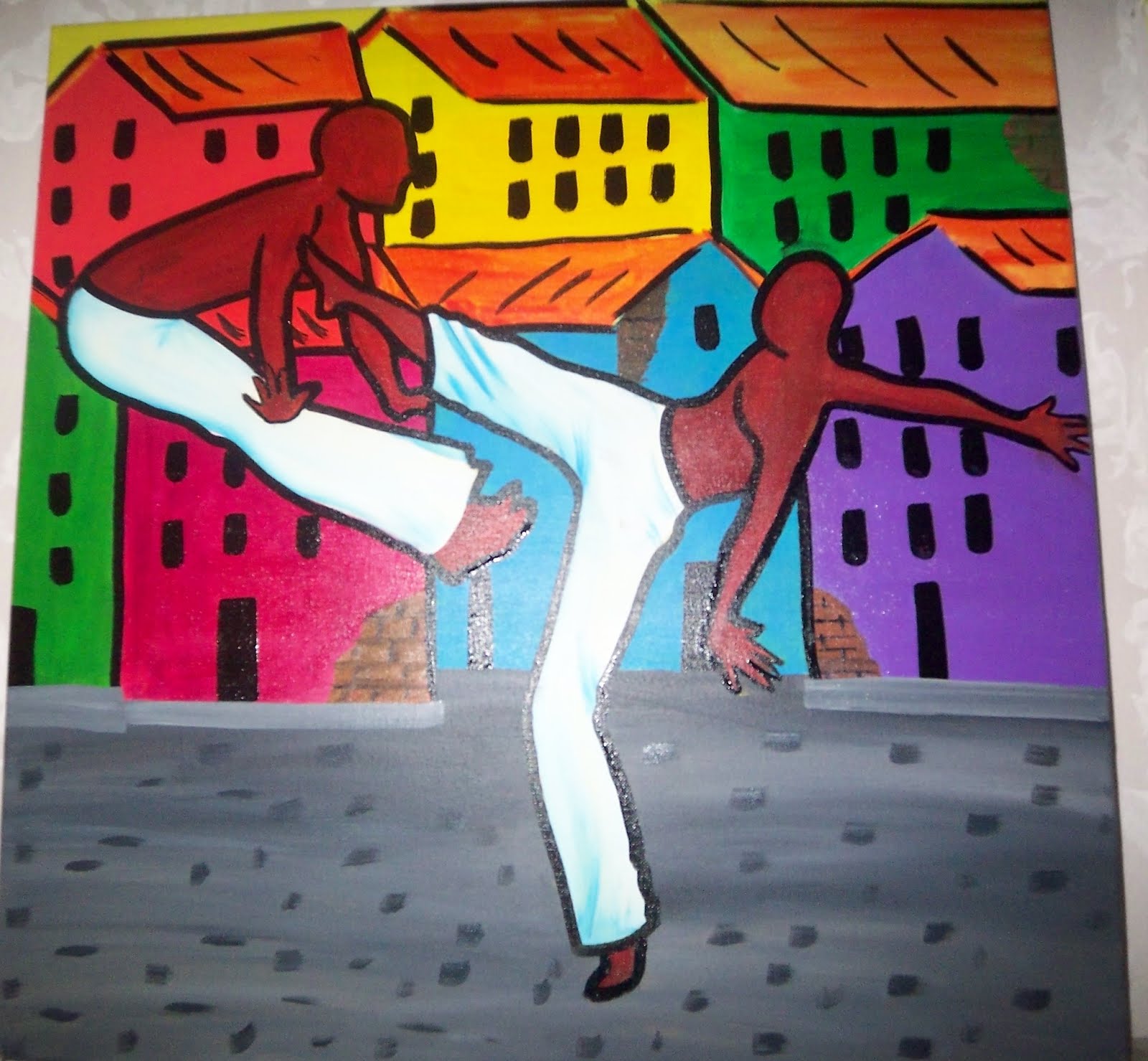
Capu 60x60 € 80


Capoeira's history probably begins with the adoption of African slavery in Brazil. Since the 16th century, Portugal extensively adopted slavery to man their colonies, coming mainly from West and Central Africa. Brazil, with its vast territory, was the major destination of African slaves, receiving 38.5% of all slaves sent by ships across the Atlantic Ocean.
Capoeira has a long and controversial history, since historical documentation in Brazil was very scarce in its colonial times. Evidences, studies and oral tradition leave little doubt about its Brazilian roots, but it is impossible to precisely identify the exact Brazilian region or time it began to take form.
Capoeira (Portuguese pronunciation: [kapuˈejɾɐ]) is a Brazilian martial art that combines elements of dance and music. It was created in Brazil mainly by descendants of African slaves with Brazilian native influences[citation needed], probably beginning in the 16th century. It is known by quick and complex moves, using mainly power, speed, and leverage for leg sweeps.
The word capoeira probably comes from Tupi, referring to the areas of low vegetation in the Brazilian interior.
In the 16th century Portugal had one of the biggest colonial empires of the world, but it lacked people to actually colonize it. In the Brazilian colony the Portuguese, like many European colonists, opted to use slavery to supply this shortage of workers. Colonists tried to enslave Brazilian natives in the beginning, but this quickly proved too difficult for many reasons, including the familiarity natives had with the land. The solution was importing slaves from Africa.[1]
In its first century the main economic activity in the colony was the production and processing of sugarcane. Portuguese colonists used to create large sugarcane farms called engenhos, farms which extensively used enslaved workers. Slaves, living in inhumane and humiliating conditions, were forced to work hard and often suffered physical punishment for any small misbehaviour.[1] Even though slaves outnumbered the Portuguese colonists, the lack of weapons, the colonial law, the disagreement between slaves coming from different African cultures and their complete lack of knowledge about the land and its surroundings would usually discourage the idea of a rebellion.
In this environment Capoeira began to develop. More than a fighting style, it was created as a hope of survival, a tool with which an escaped slave, completely unequipped, could survive in the hostile, unknown land and face the hunt of the capitães-do-mato, colonial agents armed and mounted in charge of finding escapees.

Capueira 60x60 €80

Borboletas Vk

Mathilde-San Fransisco Vk

Monalisa do sertao

Samba Vk

Donnerstag, 19. Januar 2012

Sonntag, 9. Oktober 2011

Pescadores


Fishing is the activity of trying to catch fish. Fish are normally caught in the wild. Techniques for catching fish include hand gathering, spearing, netting, angling and trapping.
The term fishing may be applied to catching other aquatic animals such as molluscs, cephalopods, crustaceans, and echinoderms. The term is not normally applied to catching farmed fish, or to aquatic mammals, such as whales, where the term whaling is more appropriate.
According to FAO statistics, the total number of commercial fishermen and fish farmers is estimated to be 38 million. Fisheries and aquaculture provide direct and indirect employment to over 500 million people.[1] In 2005, the worldwide per capita consumption of fish captured from wild fisheries was 14.4 kilograms, with an additional 7.4 kilograms harvested from fish farms.[2] In addition to providing food, modern fishing is also a recreational pastime.

Semente


" Semente"...tudo se colore em poucas cores, todos os tons de festa e como um simples céu quase em branco e azul...fica apenas as lembracas e a lembranca...de um carnaval e suas historias...

Departure


"Departure"...momento em que as ilusoes se deixam, os bracos se largam e os festins levam a outros encontros, a partida...

Enamorados


"Enamorados"....promesas ao cair dos festins e serpentinas,amor festivo que prota ali e arebenta os coracoes...

"Encontro-umbigada"...momento em que se cruzam os corpos e olhos surgindo o interece de troca puramente festivo...

Donnerstag, 21. Juli 2011

Iansã 60x80 € 80


In Yoruba mythology, Oya (Alternative spellings: Oiá, Iansã, Iansan), is the Undergoddess of the Niger River. Oya has been syncretized in Santería with the Catholic images of the Virgin of Candelaria

She is seen in aspects as the warrior-spirit of the wind, lightning, fertility, fire, and magic. She creates hurricanes and tornadoes, and guards the underworld.[1] She is the spirit of tornadoes (which are said to be her whirling skirts as she dances), lightning (the power of which she acquired from her husband, Shango), earthquakes, and any kind of destruction. Beyond destruction, Oya is the spirit of change, transition, and the chaos that often brings it about. Her association with the marketplace, and more specifically with the gates of cemeteries (as opposed to the entire underworld), reveals her in her aspect as facilitator of transition. Oyá, when danced, often has a horse tail. Her clothes have all the colors but black. She has a face expression of really big and open eyes, and she breathes and blows up her chins, and often screams.
Oya's close association with the passage from life into death also means she is one of the few Orishas which are worshiped alongside the Egun ancestors, whose cult is most often distinct from that of the Orishas. In the stories of the faith, she can transform herself into a water buffalo. One of her preferred offerings is the eggplant.

Na Mitologia Yoruba, o nome Oyá provém do rio de mesmo nome na Nigéria, onde seu culto é realizado, atualmente chamado de rio Níger. É uma divindade das águas como Oxum e Iemanjá, mas também é relacionada ao elemento ar, sendo uma das divindades que controla os ventos. Costuma ser reverenciada antes de Xangô, como o vento personificado que precede a tempestade que é uma das representações do Orixá do Fogo. Assim como a Orixá Obá, Oyá também está relacionada ao culto dos mortos, onde recebeu de Xangô a incumbência de guiá-los a um dos nove céus de acordo com suas ações, para assumir tal cargo recebeu do feiticeiro Oxóssi uma espécie de erukê especial chamado de Eruexim com o qual estaria protegida dos Eguns. O nome Iansã trata-se de um título que Oyá recebeu de Xangô que faz referência ao entardecer, Iansã=A mãe do céu rosado ou A mãe do entardecer. Era como ele a chamava pois dizia que ela era radiante como o entardecer.

Oxum 60x80 €80


Oshun, or Ochun (pronounced [ɔʃún]) in the Yoruba religion, is an Orisha who reigns over love, intimacy, beauty, wealth and diplomacy. She is worshipped also in Brazilian Candomblé Ketu, with the name spelled Oxum. She should not be confused, however, with a different Orisha of a similar name spelled "Osun," who is the protector of the Ori, or our heads and inner souls. ochun relates mostly to woman but also man.
Ọṣhun is beneficent, generous and very kind. She does, however, have a horrific temper, one which she seldom ever loses. When she does, it causes untold destruction. Oshun is said to have gone to a drum festival one day and to have fallen in love with the king-dancer Shango, god of lightning & thunder. Since that day, Shango has been married to Oba, Oya, and Oshun, though Oshun is said to be considered his principal wife.


Osun, Oshun, Ochun ou Oxum, na Mitologia Yoruba é um orixá feminino. O seu nome deriva do rio Osun, que corre na Iorubalândia, região nigeriana de Ijexá e Ijebu. Identificada no jogo do merindilogun pelos odu ejioko e Ôxê, é representada pelo candomblé, material e imaterialmente, por meio do assentamento sagrado denominado igba oxum.
Oxum é um Orixá feminino da nação Ijexá, adotada e cultuada em todas as religiões afro-brasileiras. É o Orixá das águas doces dos rios e cachoeiras, da riqueza, do amor, da prosperidade e da beleza. Em Oxum, os fiéis buscam auxílio para a solução de problemas no amor, uma vez que ela é a responsável pelas uniões, e também na vida financeira, a que se deve sua denominação de "Senhora do Ouro", que outrora era do Cobre, por ser o metal mais valioso da época.

Anjo

Reis do samba

Samba de Junino

Brasil